NTN

ATK Newmark Lite: Testing the new binding

Sep 16, 2026

The Newmark Lite: The Telemark Binding That Could Be a Game Changer
A few years ago, the renowned Italian touring binding brand entered the telemark market with the Newmark. The idea was original: to offer a particularly lightweight binding using only a Low Tech front interface for the ascent.

On paper, the concept was appealing. In practice, however, installing the downhill system proved complex, and the feel on the skis didn't entirely meet telemark skiers' expectations.

But the idea wasn't abandoned. ATK is now back with an improved version: the Newmark Lite. This new generation retains the spirit of the original concept while introducing improvements that are likely to make waves in the telemark world.

We had the opportunity to test it at the end of the season. Here are our initial impressions.

From the moment you open the box, one thing immediately stands out: the quality of the finish. ATK's expertise is instantly recognizable, with particularly meticulous machining and beautifully finished components.

It's a first impression that inspires confidence. Every detail seems to have been precisely considered, and the whole package exudes the manufacturing quality for which the Italian brand is renowned.

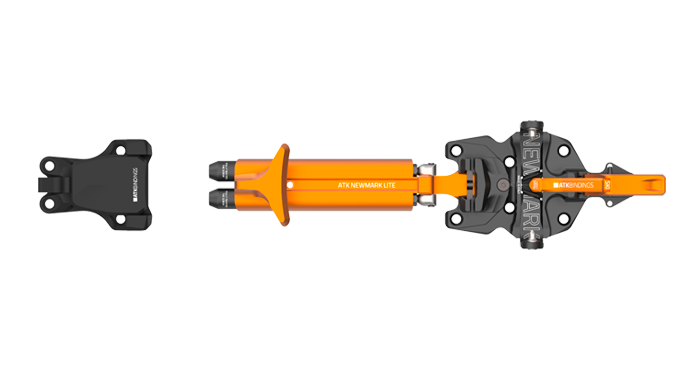
The Newmark Lite is built around two distinct elements, each with a very specific role:

- The front section uses the same principle as their Low Tech insert binding. And this is probably one of the aspects that impressed us the most during our tests:
The binding's entry proved remarkably precise, even in various snow conditions, with several types of boots (Scarpa/Crispi/Scott). This ease of use is particularly appreciated in the mountains, where conditions aren't always ideal and you don't want to struggle with your equipment.

This precise boot entry is a real advantage for a binding designed for telemark touring.

- The rear section plays a crucial role: it acts as a clamp to grip the boot and provide the control and precision needed for the descent.
This is where one of the major innovations of the Newmark Lite lies: this rear section is removable.

In practice, it can be removed for the ascent, leaving only the Low Tech front section. The weight savings are particularly significant, resulting in an extremely lightweight binding for climbing.
Once at the top, simply reattach the rear section to reactivate the complete system and enjoy the binding in downhill mode.
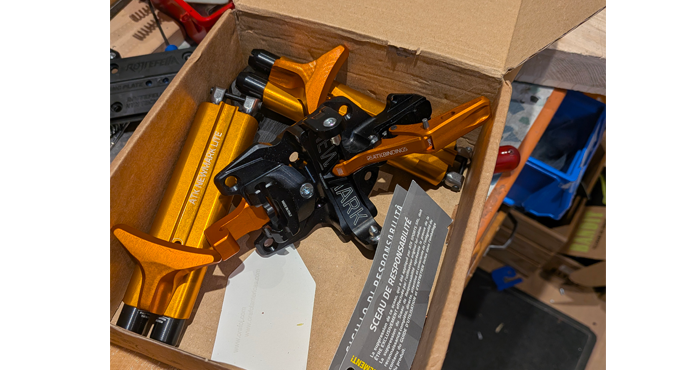
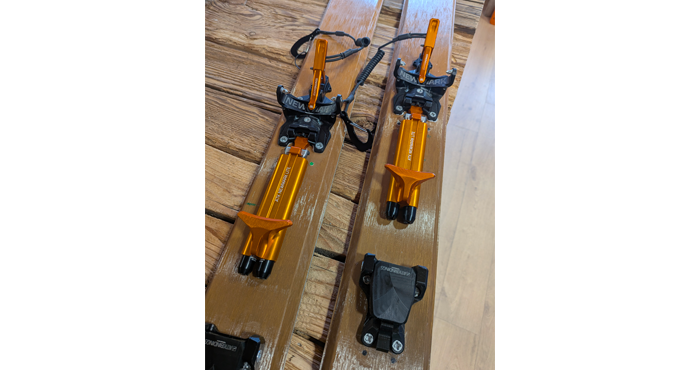
The two parts of the binding are connected by an axle, and the adjustment is easy. Switching between uphill and downhill configurations is therefore relatively intuitive. Initially, we were a little skeptical about the strength of this axle. A moving part subjected to the stresses of telemark skiing and the demands of the mountains certainly deserves special attention.
After numerous outings at the end of the season, the axle lived up to expectations and showed no worrying signs during our tests.
It now remains to be seen how this system will age over time. This is something we will continue to monitor closely, as durability will be a determining factor in fully evaluating this binding.

Another notable feature of the Newmark Lite is that there are no Small or Large sizes. The binding can be adapted to all boot sizes. Adjusting the binding is relatively easy, done internally with the correct tool (TORX screwdriver). This is a significant advantage for skiers who want to be able to adjust their equipment without complex procedures.
The Newmark Lite has only one climbing aid height. While some skiers appreciate having multiple positions to choose from, we found this height to be more than sufficient during our outings. The aid seemed robust and easy to activate. A simple system that effectively fulfills its purpose without adding unnecessary complexity.

With its six mounting points, the Newmark Lite offers a solid binding on sufficiently robust skis. We appreciated this design, which allows for confident use on heavy-duty skis. However, our test also highlighted a well-known problem in telemark skiing: the compatibility between lightweight skis, stiff boots, and bindings that transmit a lot of stress.

During our test, we unfortunately ripped off a lightweight ski (approximately 1.3 kg). This incident brings us back to a recurring question in the development of telemark equipment: how to lighten skis without compromising their resistance to the stresses exerted by modern boots and bindings? The new Scarpa boots, in particular, offer interesting stiffness (especially in the boot shell) and control, but they can also increase the stresses transmitted to the ski. With a binding that exerts a lot of pressure at the end of its travel, the entire system must be carefully sized.

This is a topic we know well, particularly through the TKS AREA anti-pull-out plate solutions from TKS, developed for certain telemark bindings (Meidjo and 22 Designs).

However, the Newmark Lite uses its own drilling pattern, different from that of the Meidjo/Simpll and 22 Designs bindings. Therefore, current TKS AREA plates are not directly compatible. A potential plate specifically designed for ATK bindings could be an interesting avenue to explore, should the need arise. Lightweight skis that can withstand the stresses of telemark skiing remain a technical challenge. This is something we will continue to monitor closely.

One minor drawback: The Newmark Lite has a limitation to consider: it is not possible to adjust the binding's stiffness. For telemark skiers who like to adapt their equipment to their skill level, skiing style, or snow conditions, this feature would be a real advantage. ATK did, however, indicate that it would eventually be possible to replace the rear springs to adjust the rigidity of the binding. This is an interesting prospect, although the details and availability of these springs remain to be determined.

It's time to get to what really interests us: its performance on the slopes. A binding might be ingenious on paper, but it's on the skis that you truly form an opinion.

As we mentioned earlier, the entry system is one of this binding's major strengths. We're all getting older, and even though the Low Tech system is fantastic in terms of weight and performance, it has to be said that it sometimes requires good eyesight and a bit of precision to get the bindings in!

With the Newmark Lite, we were blown away by the precision of the entry. With different boots and in different types of snow, the inserts proved particularly effective. A real comfort for everyday use, especially when you need to get into the bindings quickly in the mountains or when conditions aren't ideal.

The uphill locking system is easy to use. Simply pull the lever towards you, as with most Low Tech bindings. No complicated setup required: the operation is intuitive and easy to learn. This is a real plus when you're constantly switching between climbing and descending.

On the descent, the binding also features a safety adjustment that allows you to adjust the release mechanism in case of a fall. This adjustment is made using a screw to adapt the opening resistance. There doesn't seem to be a weight-based adjustment, so this will need to be tested in practice.

Telemark skiing requires an adjustment period. This is probably where our experience is most nuanced. It took us some time to get used to the feel of the Newmark Lite. From our perspective, the binding is a bit too soft and lacks progression. You reach the toe stop quickly, which limits control of the inside ski.
This doesn't mean the system doesn't work, but rather that it requires adaptation and its performance could be improved. ATK indicated that stiffer springs might be offered later for the rear section. If this development is confirmed, it could provide more progression and control, making the experience more enjoyable.

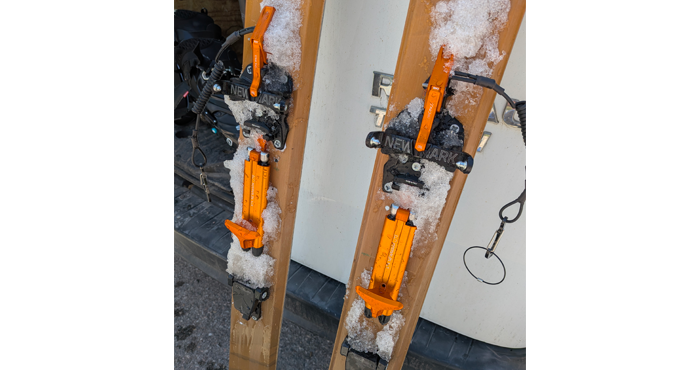
Another pleasant surprise during our outings: the Newmark Lite is very resistant to snow buildup under the binding. This may seem like a minor detail, but it becomes valuable when conditions are changing and snow gets trapped in the mechanisms or under the binding components. However, we did encounter a minor issue twice with the screws located under the binding. ATK informed us that this problem would be corrected on the new model.

In terms of specifications: The Newmark Lite is advertised at 680 grams, placing it in the category of lightweight telemark touring bindings. Its advertised price of €599 puts it in the middle of the pack for bindings of this type. It is therefore positioned as a solution to consider for skiers with a focus on touring/backcountry.
The option to add an alpine heel piece will make it much more versatile and appeal to a wider range of skiers. The price will be €699.

Our verdict after testing: After several outings, the Newmark Lite left us with an interesting and mixed impression. On the one hand, we appreciated the build quality, the precision of the entry mechanism, the simplicity of the climbing system, and the option to remove the heel piece to save weight. These are compelling arguments for telemark touring. On the other hand, the downhill feel required some adjustment, with a flexibility and progressiveness that didn't entirely match our current preferences. The announced developments regarding the springs could be interesting to follow.

The issue of the durability of lightweight skis also remains an important one, as we observed during our test.

The Newmark Lite is therefore an innovative binding with strong selling points, but its potential still needs to be explored further in real-world conditions and over time.

Vous voulez des cookies ?
Ce site utilise des cookies pour garantir la meilleure expérience de navigation.
Accept
Decline